How Many Google Reviews Does an Auto Body Shop Need in 2026?
Short answer: at least 20, rated 4.5 or better, with a steady flow of new ones every month. Here's why each of those three numbers matters, and why getting two out of three still loses you work.
The filter: 20 reviews and 4.5 stars
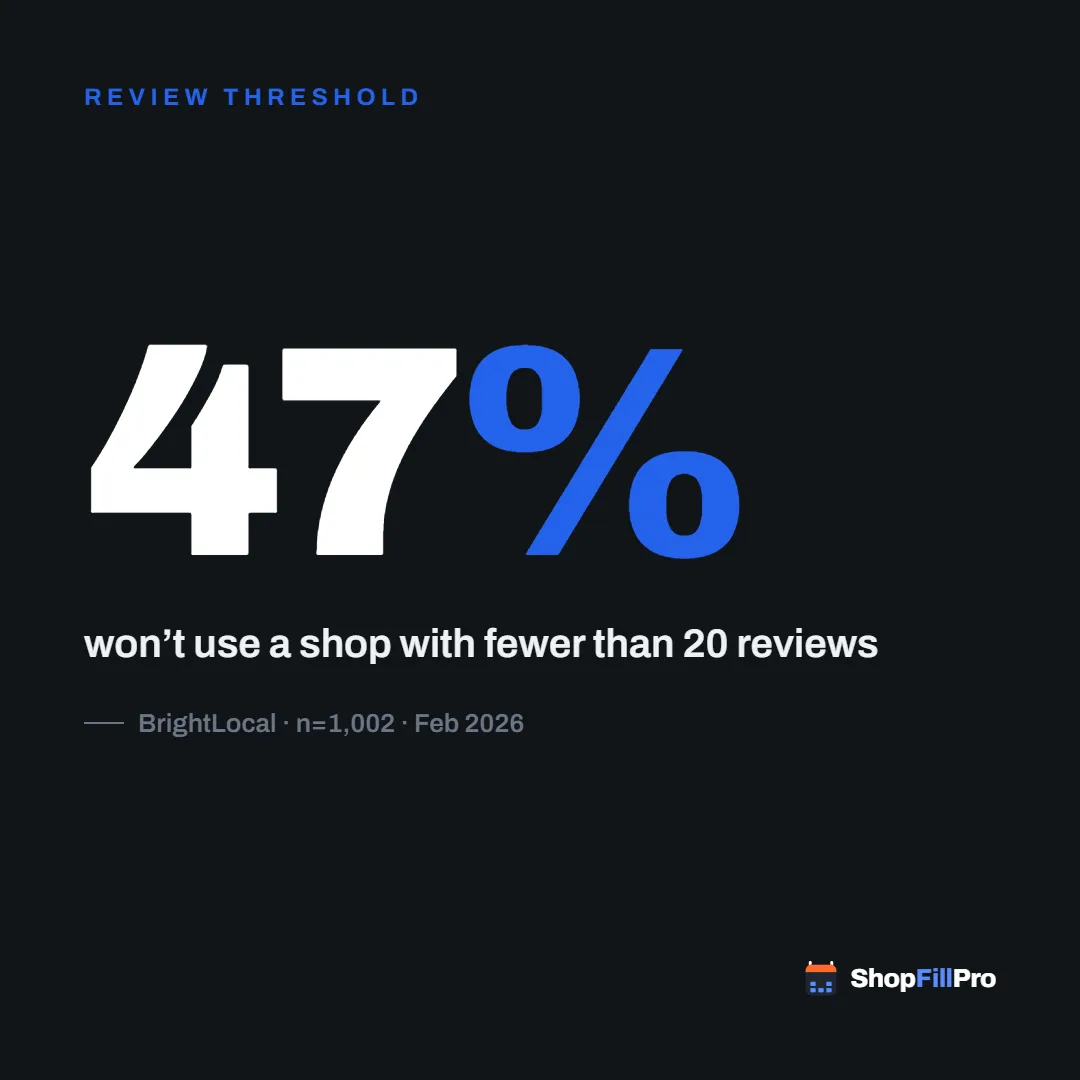
BrightLocal surveyed 1,002 US consumers in February 2026. 47% won't use a business with fewer than 20 reviews. Nearly half of your potential customers rule you out before they read a single word, purely on the count.
The rating threshold tightened hard this year. 31% will only use a business rated 4.5 stars or better, up from 17% the year before. 68% won't go below 4.0. A 4.3 was comfortably fine in 2025. In 2026 it removes you from consideration for a third of the market.
If you're sitting on 12 reviews and a 4.3, you're not competing on price or quality. You're getting filtered out before either comes up.
The catch: your reviews expire
74% of consumers only consider reviews from the last three months. Nearly a third only look at the last two weeks.
Your back catalogue still works. It holds your star average and your review count, and that keeps you above the 20-review filter. That part doesn't expire. What expires is the reading. Sixty five-star reviews from 2023 keep you in the running, but almost nobody is reading them. The shop with eight reviews from last month is the one being read.
Volume gets you considered. Recency is what gets read.
What Google counts (it's not what you think)
Star rating and review text are two different ranking factors with two different jobs. High ratings rank #6 of 187. Quantity of reviews with text ranks #9, separately. Google's factor is specifically reviews with text. A silent five-star tap isn't what's being counted there. Review recency ranks #11.
Which changes what a review request has to do. A one-tap five-star ask gets you the rating and nothing that ranks. The request has to get the customer to name the job, the brake work, the insurer, the turnaround, without reading like homework, and it has to land while they still remember it. That's the difference between a review program and a sign by the till.
Replies matter too, and templates hurt
80% of consumers are more likely to use a business that replies to all of its reviews. 50% are put off by replies that read like a template. We looked at six shops in one market recently. Only one replied to reviews at all, and it was the one with the lowest rating. The 4.8-star shop with nearly a hundred reviews had a detailed, credible complaint sitting unanswered from last month. Every prospective customer who sorts by "newest" reads it first.
What to do
- Count your reviews from the last 90 days. If it's under five, recency is your problem, not volume.
- Reply to every review, including the bad ones, in your own words.
- Ask for reviews the day the car leaves, and ask the customer to mention what was done.
Holding the count, the rating, and the recency every month is a system, not a one-time push. It's part of what we run for the shops we work with, alongside the profile fields that carry the top ranking factors.
Want to know where your shop actually stands? Book a 15-minute call and we'll pull your Google ranking live across your service area and run your numbers with you. No pitch if it's not a fit. Book a call.
Sources: BrightLocal Local Consumer Review Survey, February 2026 (n=1,002); Whitespark Local Search Ranking Factors, November 2025.
